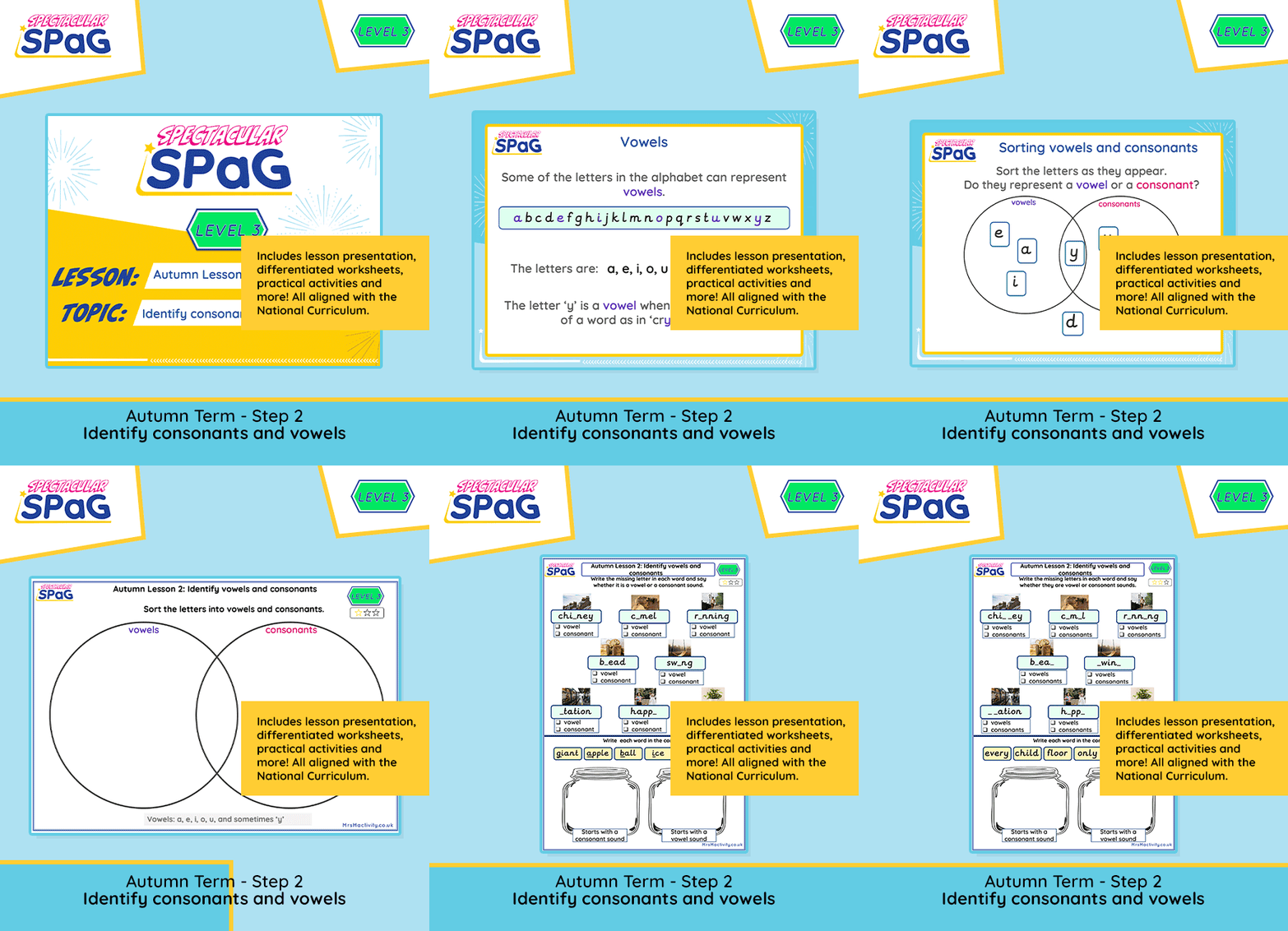
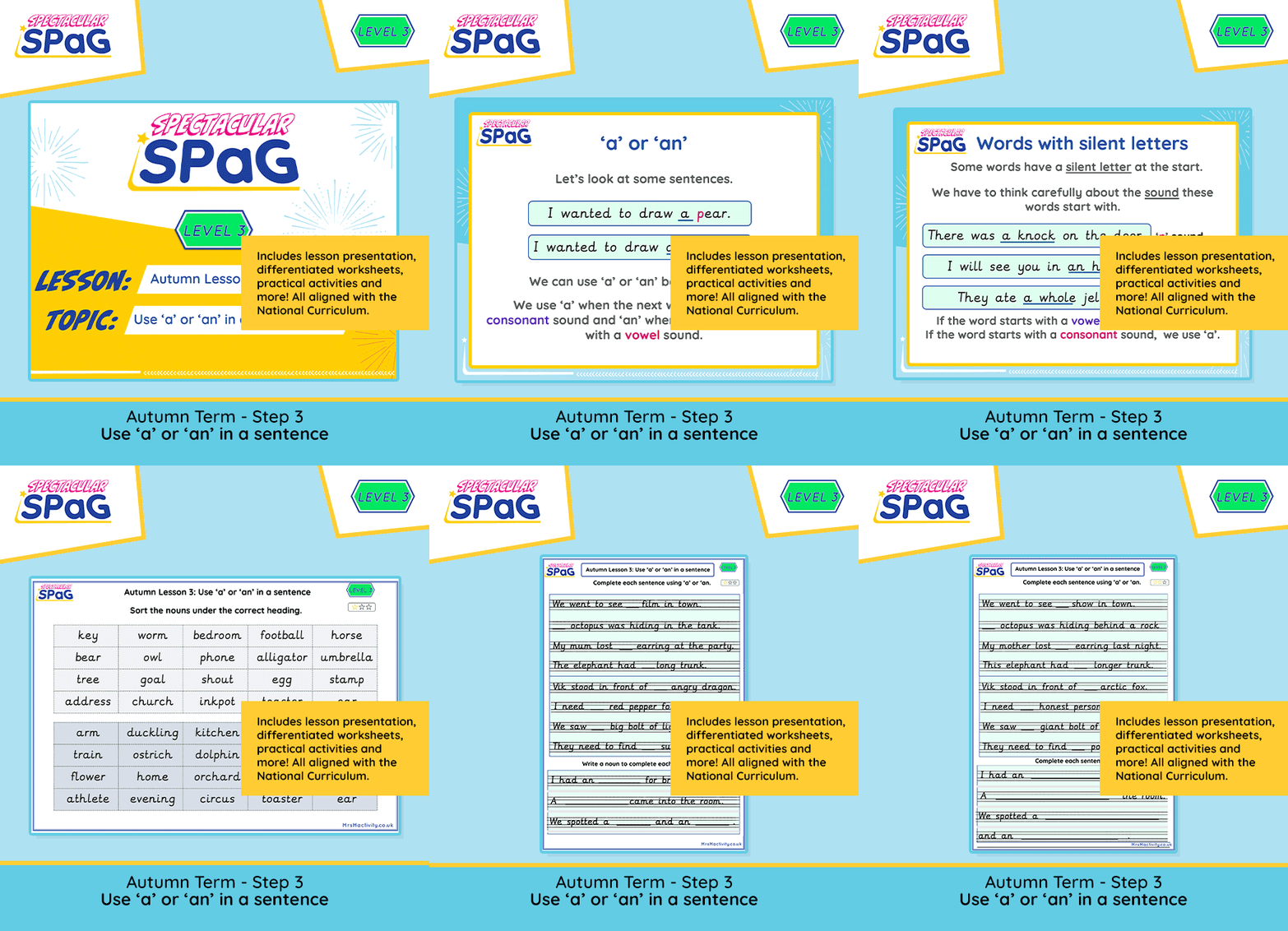
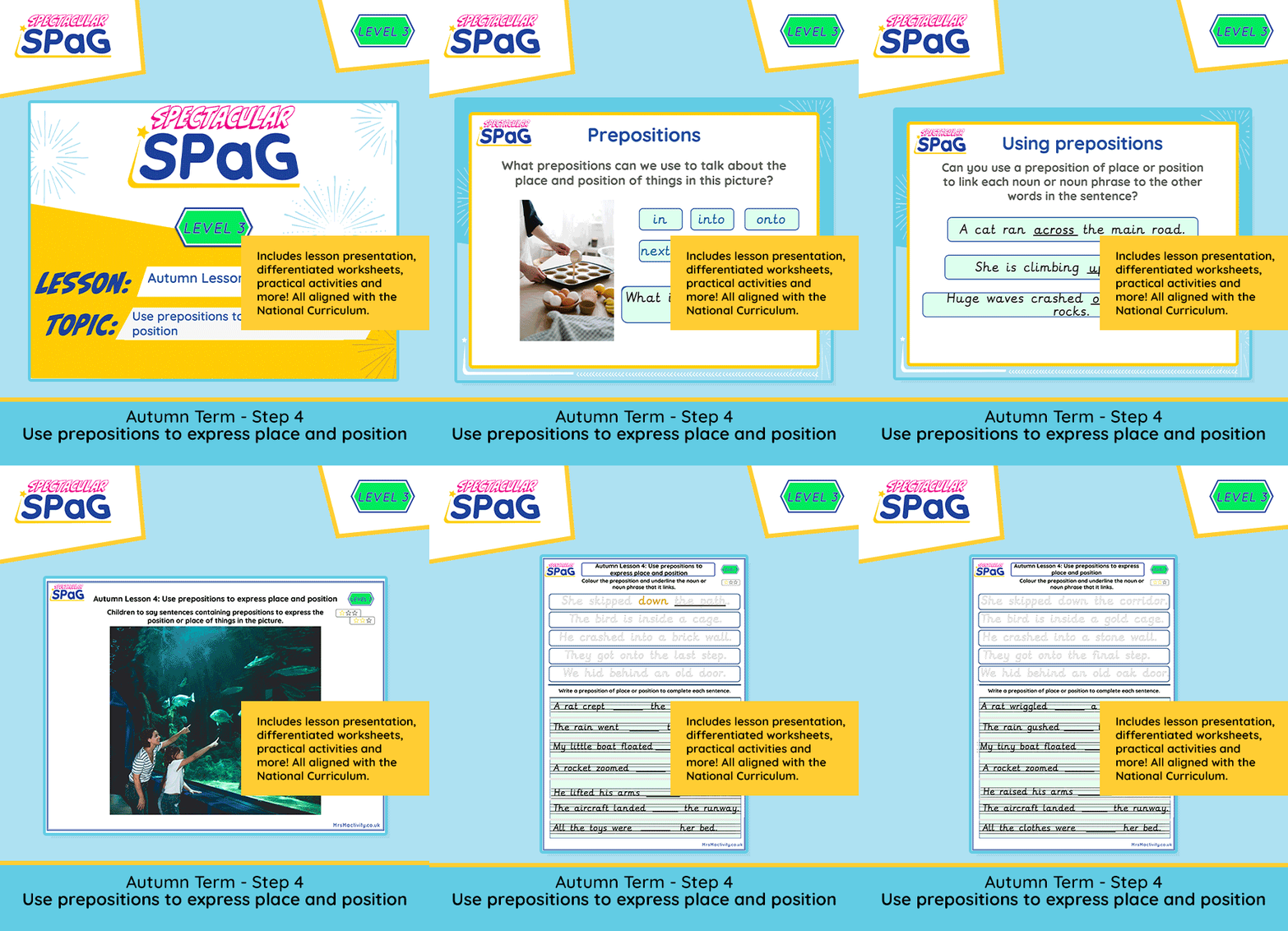
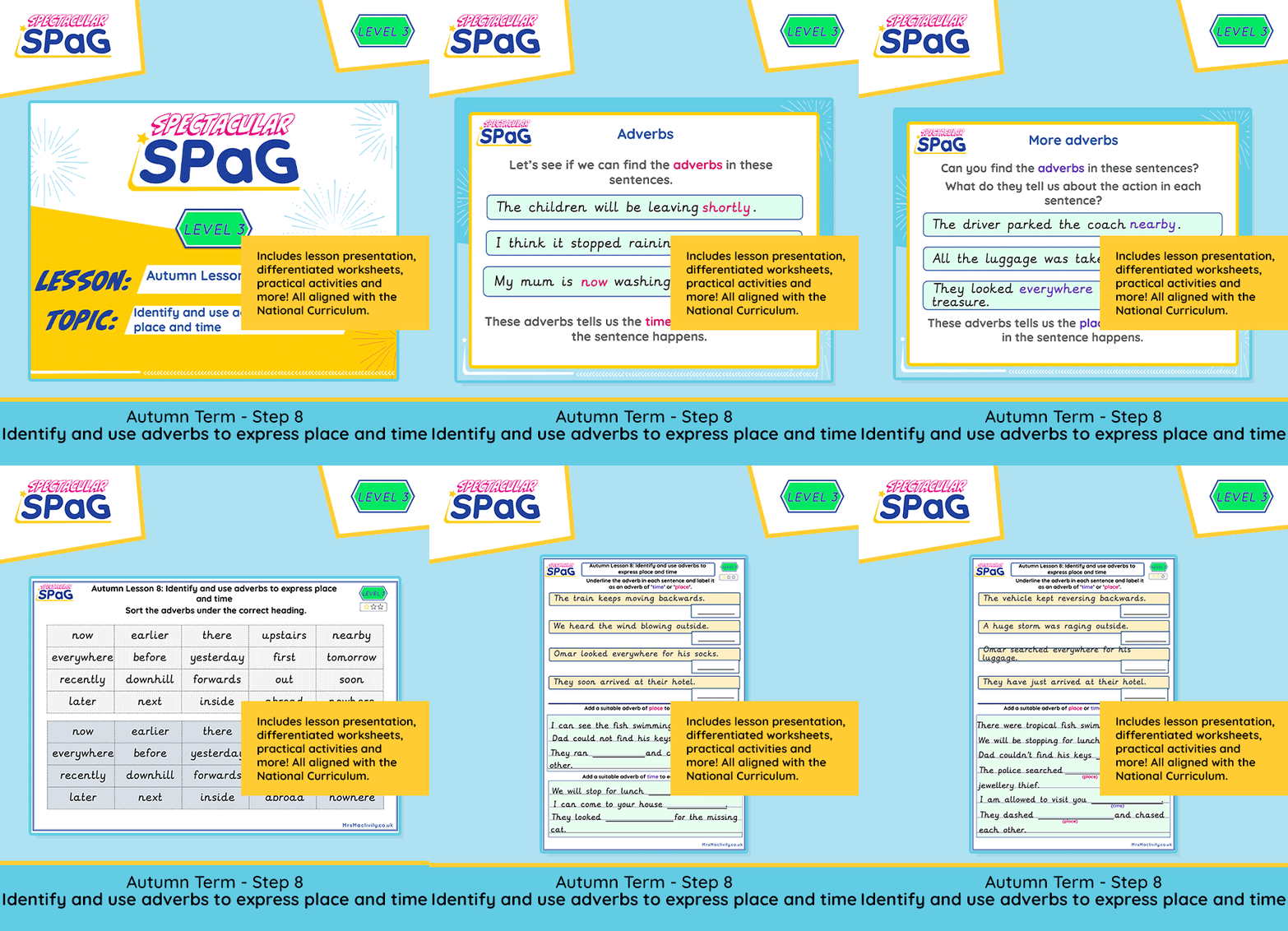
Teach Year 3 SPaG with nine carefully sequenced Autumn term lesson packs, fully aligned to the Year 3 grammar and punctuation National Curriculum objectives. Pupils revisit key Year 2 grammar before learning to use a and an correctly, explore prepositions, conjunctions and adverbs, recognise the present perfect tense and begin using inverted commas for direct speech.
Begin with the Year 3 Autumn lesson plans and rationale for an overview of the teaching sequence. You’ll also find assessments, progression documents and a linked Year 3 Autumn spelling strand covering the Year 3 spelling objectives, with weekly spelling lists, dictation activities and supporting resources.
Looking for the full Year 3 SPaG scheme?
Explore the complete Year 3 SPaG scheme, including Autumn, Spring and Summer lesson packs, planning and progression.
Follow the nine small-step lessons below to teach the complete Year 3 Autumn SPaG sequence, building pupils’ grammar and punctuation knowledge across the Autumn term.
Everything you need to plan, teach and assess the Year 3 Autumn SPaG curriculum in one place. Download the lesson plans and rationale to understand the teaching sequence, then use the baseline assessment, end of term assessment, assessment tracker and long-term overview to measure progress and ensure full coverage of the Year 3 National Curriculum objectives across the Autumn term.
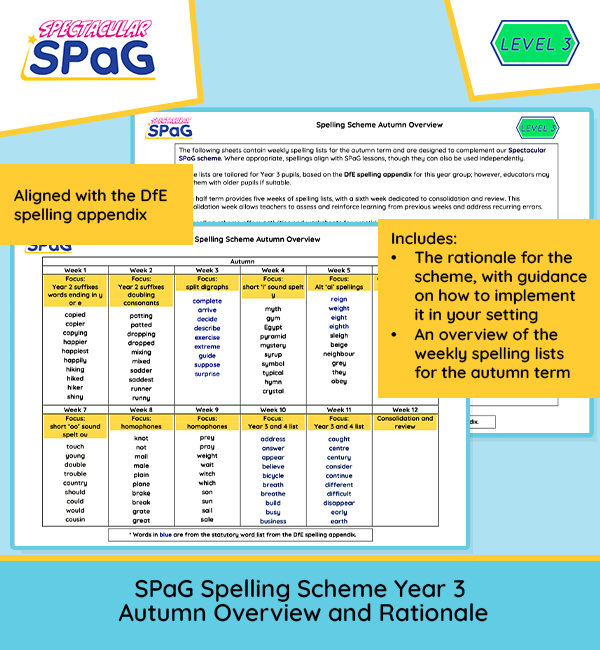
Every term of our Year 3 SPaG scheme is supported by a dedicated spelling strand, designed to be taught alongside the grammar and punctuation lessons. The Year 3 Autumn spelling sequence introduces the statutory spelling rules and patterns for the Autumn term through weekly spelling lists, dictation activities, handwriting sheets and clear progression that complements the SPaG curriculum.
Alongside the weekly resources, you’ll also find our popular spelling rules PowerPoints, helping teachers introduce new spelling patterns explicitly before pupils practise and apply them. The collection also includes a term overview and rationale, making it straightforward to plan and teach spelling alongside the Autumn SPaG lesson sequence.
Year 3 Autumn SPaG begins by revisiting important Year 2 grammar before introducing new Key Stage 2 concepts. Pupils learn to use a and an correctly, identify prepositions, conjunctions and adverbs that express time, place and cause, recognise the present perfect tense and begin to identify direct speech using inverted commas. This carefully sequenced approach helps pupils make a confident transition into Lower Key Stage 2.
How does the Year 3 Autumn SPaG scheme support progression?
The scheme starts by consolidating essential grammar knowledge from Year 2 before introducing new Year 3 objectives in manageable small steps. This approach helps pupils build secure understanding before applying new grammar and punctuation skills in their own writing.
What is included in each Year 3 Autumn SPaG lesson pack?
Each lesson pack includes a PowerPoint, practical activity and differentiated worksheets, making it easy to teach each objective from start to finish. The term also includes lesson plans and rationale, baseline and end of term assessments, an assessment tracker and progression documents to support planning and assessment.
Does the Year 3 Autumn SPaG scheme follow the National Curriculum?
Yes. Every lesson is mapped to the National Curriculum English Appendix 2 and follows a logical sequence that develops pupils’ grammar, punctuation and vocabulary knowledge across the Autumn term.
Is there a matching Year 3 Autumn spelling programme?
Yes. The Year 3 Autumn spelling strand has been designed to complement the SPaG lessons and includes weekly spelling lists, spelling rules PowerPoints, dictation activities, handwriting sheets and a term overview with planning guidance.
Can these Year 3 SPaG resources be used for intervention or mixed-age teaching?
Yes. As the worksheets are labelled by the grammar objective rather than the year group, they’re ideal for mixed-age classes, intervention groups and pupils who need additional consolidation of specific SPaG concepts.
Award-winning resources, trusted by thousands of teachers and schools
We use cookies on our website to give you the most relevant experience by remembering your preferences and repeat visits. By clicking “Accept”, you consent to the use of ALL the cookies.
This website uses cookies to improve your experience while you navigate through the website. Out of these, the cookies that are categorised as necessary are stored on your browser as they are essential for the working of basic functionalities of the website. We also use third-party cookies that help us analyse and understand how you use this website. These cookies will be stored in your browser only with your consent. You also have the option to opt-out of these cookies. But opting out of some of these cookies may affect your browsing experience.
Necessary cookies are absolutely essential for the website to function properly. This category only includes cookies that ensures basic functionalities and security features of the website. These cookies do not store any personal information.
Functional cookies help to perform certain functionalities like sharing the content of the website on social media platforms, collect feedbacks, and other third-party features.
Performance cookies are used to understand and analyze the key performance indexes of the website which helps in delivering a better user experience for the visitors.
Analytical cookies are used to understand how visitors interact with the website. These cookies help provide information on metrics the number of visitors, bounce rate, traffic source, etc.
Cookie
Duration
Description
_fbp
3 months
Facebook sets this cookie to display advertisements when either on Facebook or on a digital platform powered by Facebook advertising after visiting the website.
_ga
1 year 1 month 4 days
Google Analytics sets this cookie to calculate visitor, session and campaign data and track site usage for the site's analytics report. The cookie stores information anonymously and assigns a randomly generated number to recognise unique visitors.
_ga_*
1 year 1 month 4 days
Google Analytics sets this cookie to store and count page views.
_gcl_au
3 months
Google Tag Manager sets the cookie to experiment advertisement efficiency of websites using their services.
Advertisement cookies are used to provide visitors with relevant ads and marketing campaigns. These cookies track visitors across websites and collect information to provide customized ads.
Cookie
Duration
Description
fr
3 months
Facebook sets this cookie to show relevant advertisements by tracking user behaviour across the web, on sites with Facebook pixel or Facebook social plugin.
NID
6 months
Google sets the cookie for advertising purposes; to limit the number of times the user sees an ad, to unwanted mute ads, and to measure the effectiveness of ads.
VISITOR_INFO1_LIVE
6 months
YouTube sets this cookie to measure bandwidth, determining whether the user gets the new or old player interface.
VISITOR_PRIVACY_METADATA
6 months
YouTube sets this cookie to store the user's cookie consent state for the current domain.
YSC
session
Youtube sets this cookie to track the views of embedded videos on Youtube pages.
yt-remote-connected-devices
never
YouTube sets this cookie to store the user's video preferences using embedded YouTube videos.
yt-remote-device-id
never
YouTube sets this cookie to store the user's video preferences using embedded YouTube videos.
yt.innertube::nextId
never
YouTube sets this cookie to register a unique ID to store data on what videos from YouTube the user has seen.
yt.innertube::requests
never
YouTube sets this cookie to register a unique ID to store data on what videos from YouTube the user has seen.