Communication & Language • Vocabulary • Reception
Tilly’s Voyage into Vocabulary is one of the six-week intervention units within the Foundations for Learning Intervention Programme (FLIP). It is designed to support Reception children who would benefit from additional help to develop and extend their vocabulary and use of language.
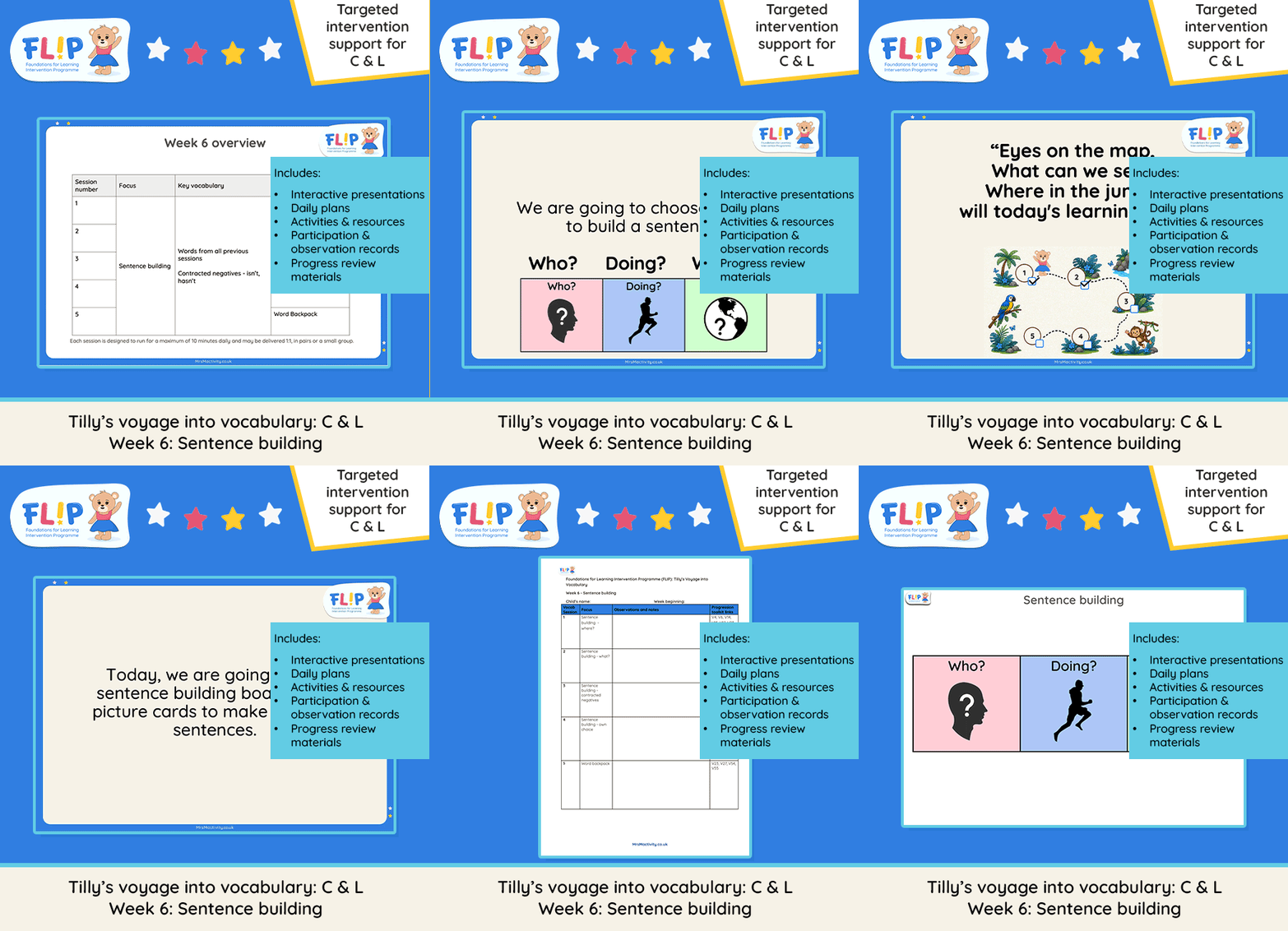
Through short, structured daily sessions, children develop their understanding and use of new vocabulary, learn to categorise and connect words, explore concepts and comparisons, and use their growing vocabulary to build sentences.

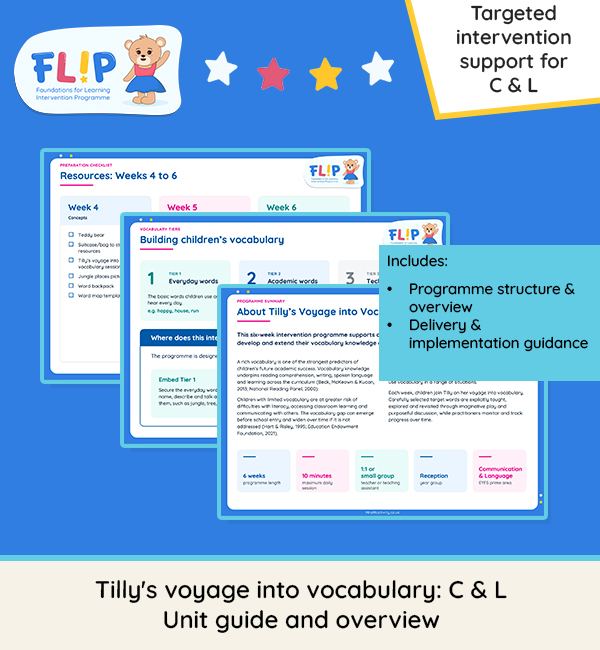
Start with the Unit Guide to prepare, deliver and review the programme.
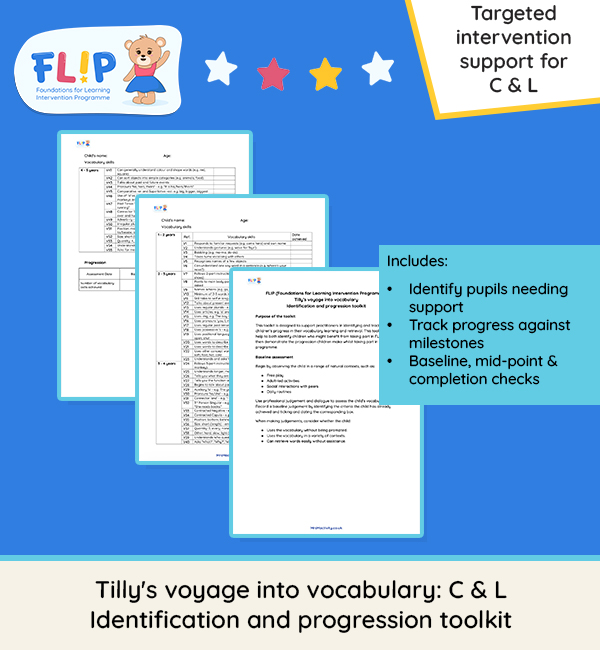
Use the Identification & Progression Toolkit to identify children, monitor progress and plan next steps.
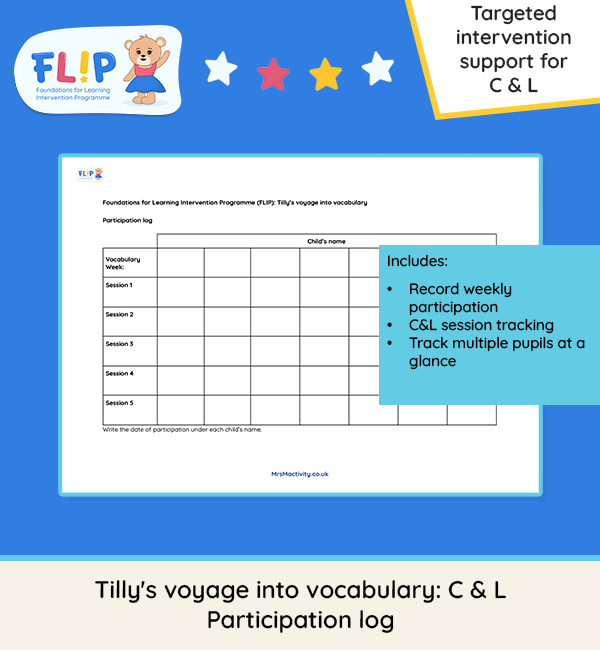
Keep a clear record of each child’s participation across the sessions.
Access each week’s planning, presentation slides and practical resources as Tilly travels through the vocabulary jungle, with each week building on the last to develop children’s understanding and use of new words.
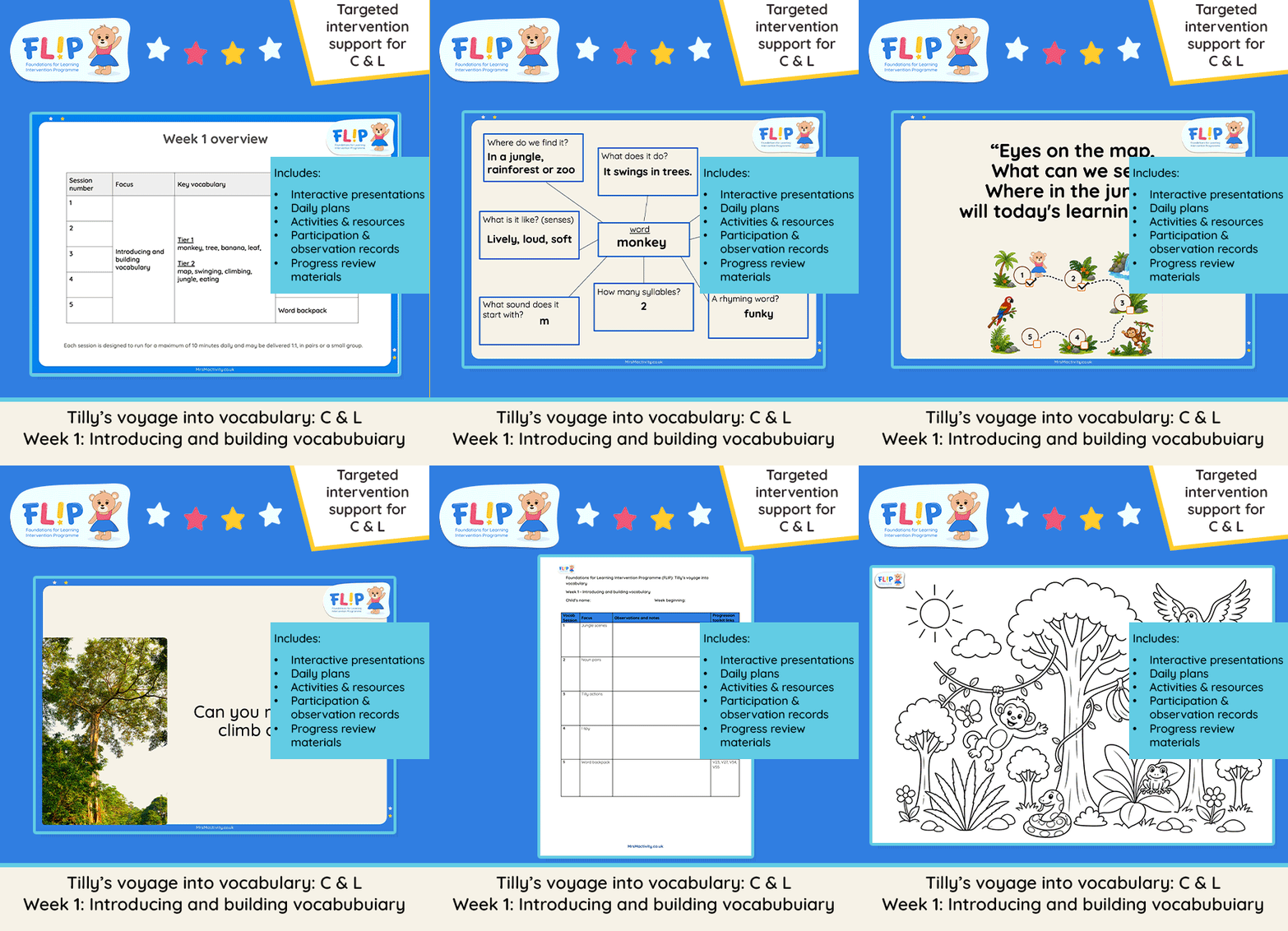
Children explore and build new vocabulary through jungle-themed activities, including naming objects, actions and describing what they can see.
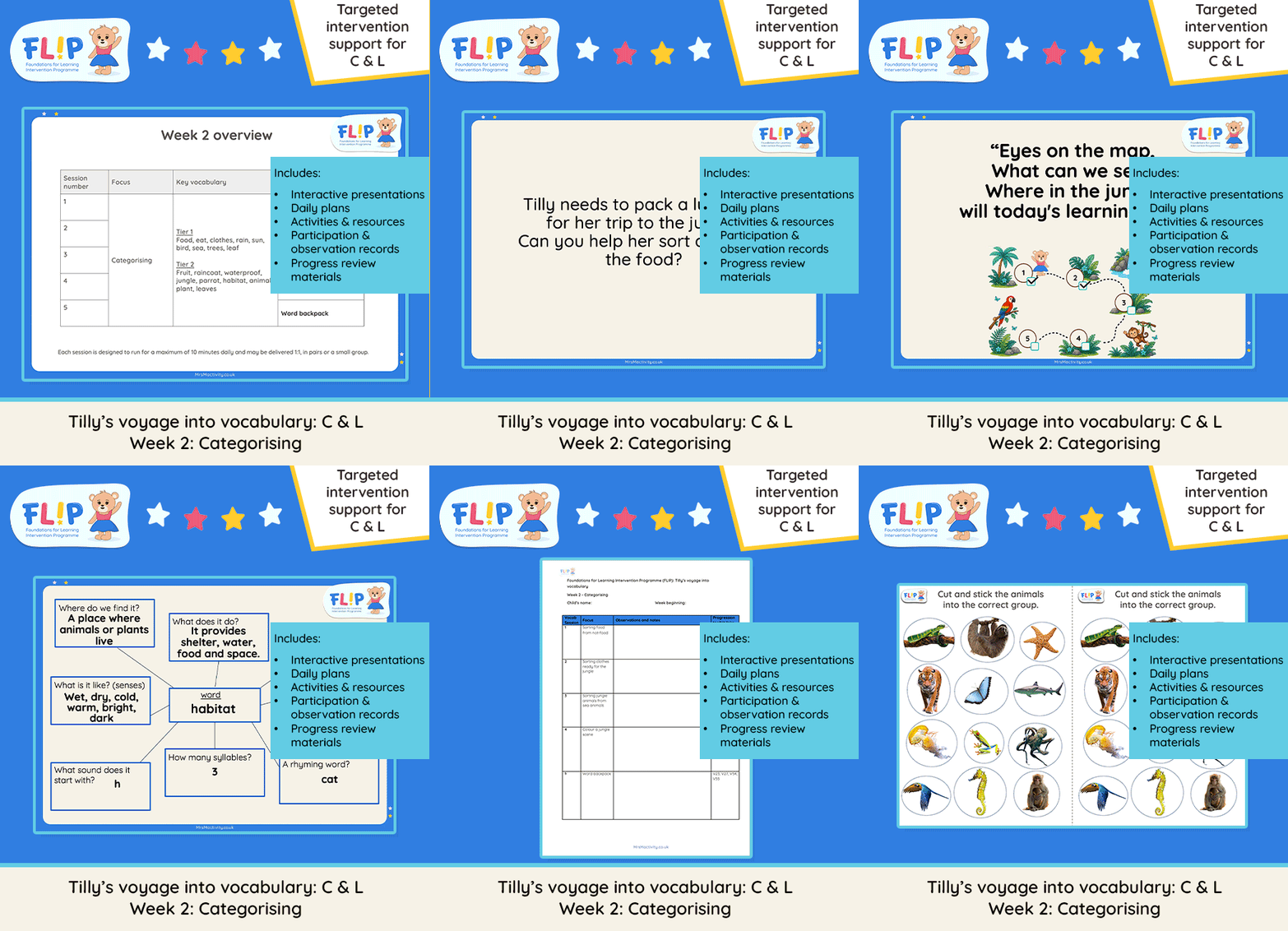
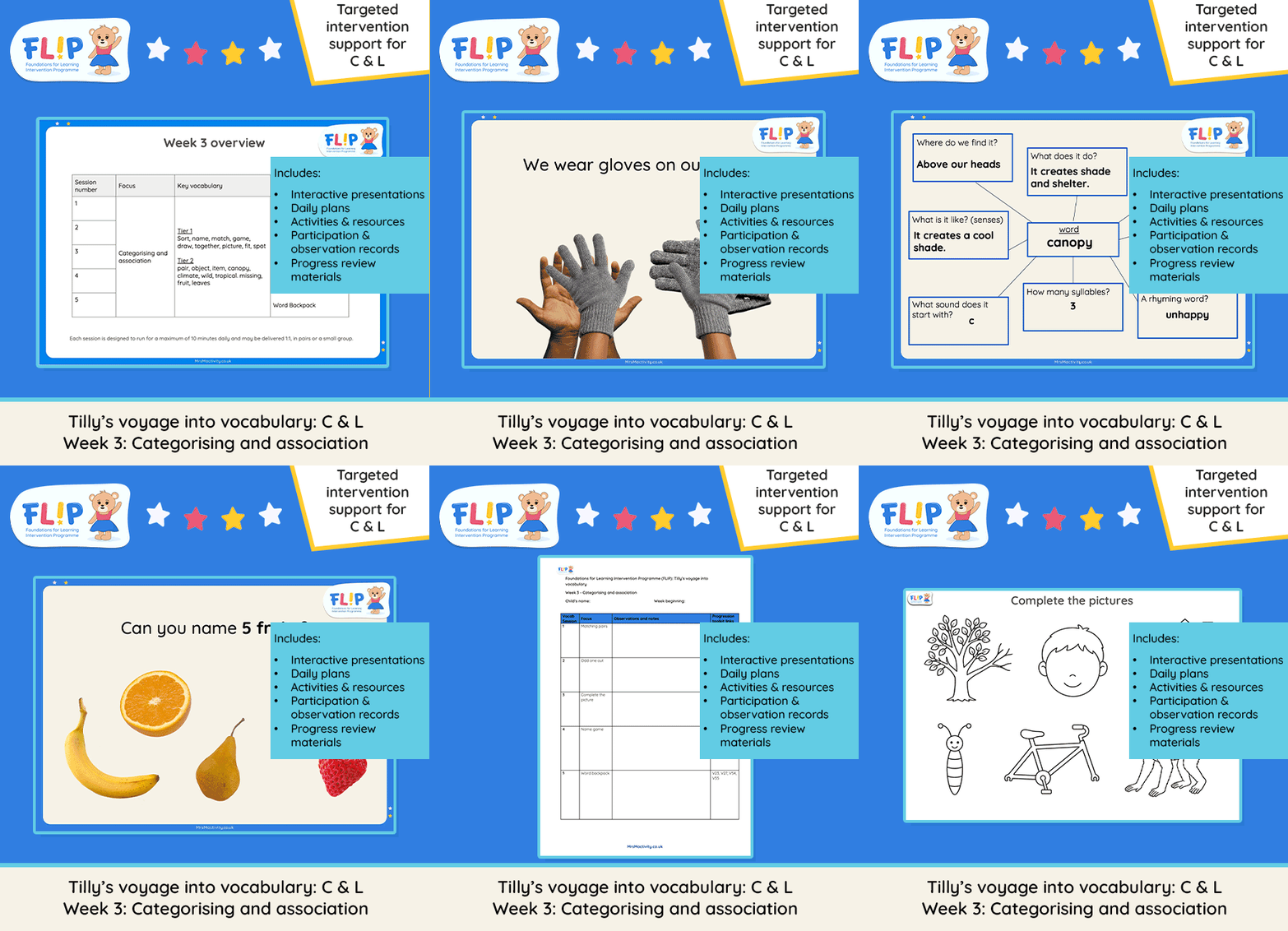
Children develop vocabulary by sorting and grouping familiar objects, clothing, food and animals into meaningful categories.
Children make connections between words by matching related objects, spotting odd ones out and identifying items that belong together.
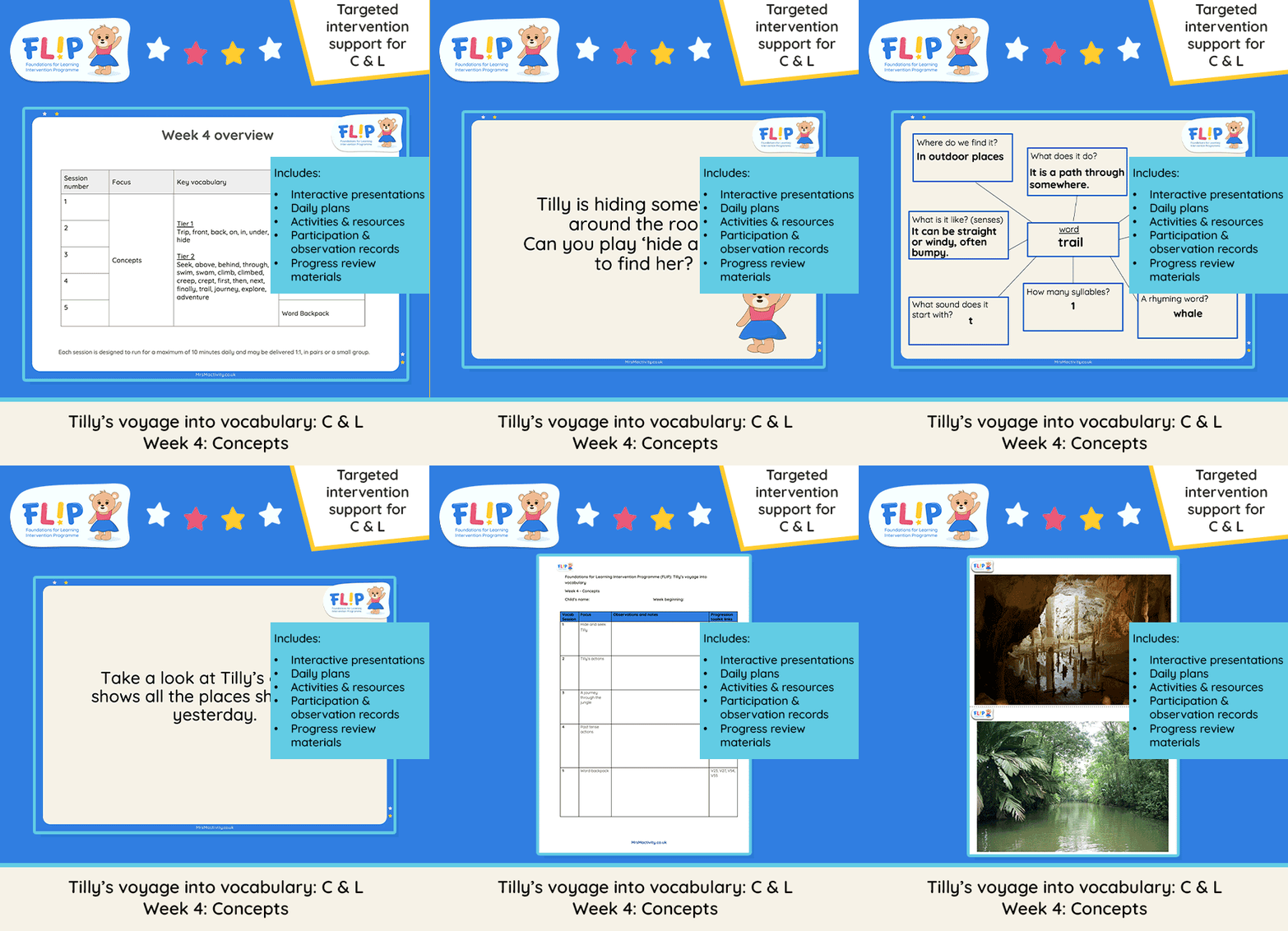
Children develop their understanding of concepts including position, actions, sequencing and past-tense language.
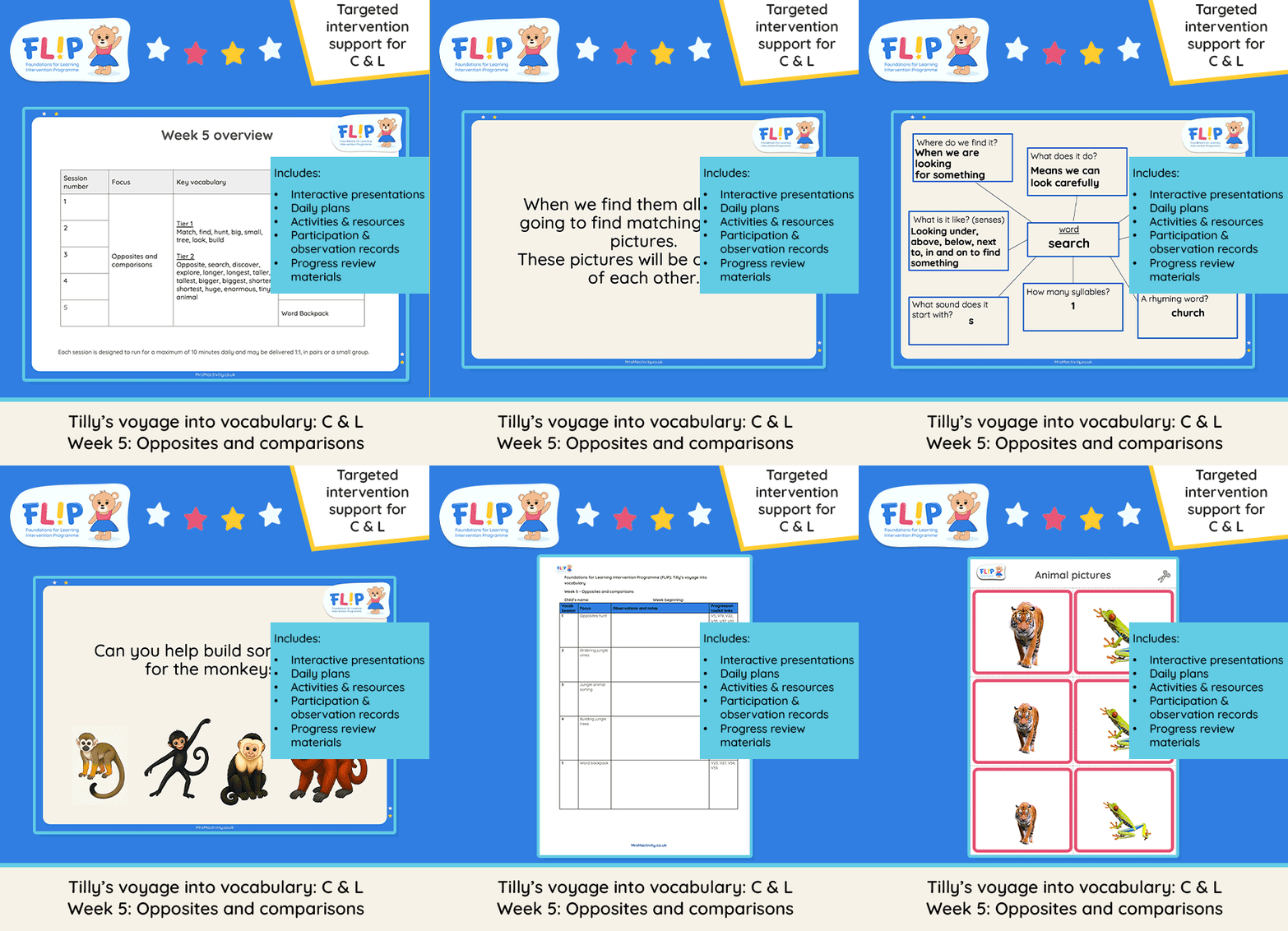
Children explore opposites and use comparative vocabulary to describe and compare size, length and height.
Tilly’s Voyage into Vocabulary is one unit within the Foundations for Learning Intervention Programme (FLIP). Explore the main FLIP programme to discover other targeted Reception interventions and learn more about the wider approach to identifying need, delivering support and monitoring progress over time.
Explore the FLIP programme →Tilly’s Voyage into Vocabulary is designed for children in Reception (ages 4–5) who would benefit from additional support to develop and extend their vocabulary and use of language. It can be used with individual children or small groups as a targeted intervention alongside high-quality classroom teaching.
Tilly’s Voyage into Vocabulary runs for six weeks, with one short session each day. Each session is designed to take no more than 10 minutes, making it easy to fit into the Reception day.
Yes. The six weeks are designed to build progressively, moving from introducing and understanding new vocabulary through categorising and making connections between words, to exploring concepts, comparisons and opposites, and finally building sentences. For the strongest progression, we recommend completing the weeks in order.
Yes. The activities can be adapted to suit the individual needs of the children taking part. You can provide additional modelling, repetition or support where needed, while keeping the weekly vocabulary focus and progression in place.
Tilly’s Voyage into Vocabulary focuses on developing children’s understanding and use of vocabulary. Children learn to understand and use new words, categorise and make connections between words, explore concepts, comparisons and opposites, and use their growing vocabulary to build sentences.
Yes. Tilly’s Voyage into Vocabulary can be particularly useful for children with SEND or identified communication and language needs who would benefit from targeted vocabulary support. Sessions can be adapted to each child’s needs, with additional repetition, modelling and processing time where appropriate.
Most of what you need is included within the weekly intervention packs. You’ll also need a teddy bear to use as Tillyand a suitcase or bag to store the resources, along with a small number of everyday items such as children’s scissors and sorting hoops for particular sessions.
Use the Identification & Progression Toolkit, Participation Log and Practitioner Notes to record observations, monitor children’s progress throughout the programme and review next steps.
No. Tilly and the Journey of Me has been designed to be straightforward to deliver using the included practitioner guidance and resources. Anyone delivering the intervention should have the appropriate knowledge, skills and experience to support young children and respond to their individual needs.
Yes. Children may complete one FLIP unit or several, depending on the areas in which they would benefit from additional support. Professional judgement should be used when deciding which intervention is most appropriate for each child.
FLIP has been designed to fit into everyday school practice and doesn’t require any specialist equipment.
To deliver sessions, you’ll need:
All equipment and preparation requirements are clearly explained within each FLIP unit, helping practitioners set up sessions quickly and confidently.
Yes. FLIP has been developed using established educational research and national guidance relating to early intervention, communication and language, personal, social and emotional development, physical development and inclusive practice. Throughout the programme we reference evidence from organisations including the Education Endowment Foundation, Ofsted and the Department for Education. While these organisations do not endorse FLIP, their research has informed its design.
The Department for Education’s Inclusive Mainstream Fund is intended to help mainstream schools strengthen inclusive practice through early identification, evidence-informed decision making and targeted intervention. FLIP has been developed around these same principles. Individual funding decisions remain the responsibility of schools and local authorities, so schools should always refer to the latest national and local guidance when deciding how funding is used.
Schools may choose to purchase FLIP through a range of existing budgets, depending on local priorities and funding arrangements. This may include curriculum budgets, SEND or inclusion budgets, Early Years Pupil Premium or other funding streams where appropriate. Schools should always follow their own financial procedures and local authority guidance. Pricing details are here.
FLIP combines early identification, structured intervention and progress monitoring within one consistent framework. Rather than providing isolated activities, each unit includes an Identification Toolkit, practitioner guidance, lesson presentations, practical activities and assessment materials, helping schools deliver targeted intervention with confidence.
Take a look at a complete week of FLIP with Week 1 of Tilly’s Travel Tales, our Communication & Language and Physical Development intervention. It’s free, with no membership required.
| Cookie | Duration | Description |
|---|---|---|
| _fbp | 3 months | Facebook sets this cookie to display advertisements when either on Facebook or on a digital platform powered by Facebook advertising after visiting the website. |
| _ga | 1 year 1 month 4 days | Google Analytics sets this cookie to calculate visitor, session and campaign data and track site usage for the site's analytics report. The cookie stores information anonymously and assigns a randomly generated number to recognise unique visitors. |
| _ga_* | 1 year 1 month 4 days | Google Analytics sets this cookie to store and count page views. |
| _gcl_au | 3 months | Google Tag Manager sets the cookie to experiment advertisement efficiency of websites using their services. |
| Cookie | Duration | Description |
|---|---|---|
| edd-rvi | 3 months | Description is currently not available. |
| GFE_RTT | 5 minutes | No description available. |
| m | 1 year 1 month 4 days | No description available. |
| Cookie | Duration | Description |
|---|---|---|
| fr | 3 months | Facebook sets this cookie to show relevant advertisements by tracking user behaviour across the web, on sites with Facebook pixel or Facebook social plugin. |
| NID | 6 months | Google sets the cookie for advertising purposes; to limit the number of times the user sees an ad, to unwanted mute ads, and to measure the effectiveness of ads. |
| VISITOR_INFO1_LIVE | 6 months | YouTube sets this cookie to measure bandwidth, determining whether the user gets the new or old player interface. |
| VISITOR_PRIVACY_METADATA | 6 months | YouTube sets this cookie to store the user's cookie consent state for the current domain. |
| YSC | session | Youtube sets this cookie to track the views of embedded videos on Youtube pages. |
| yt-remote-connected-devices | never | YouTube sets this cookie to store the user's video preferences using embedded YouTube videos. |
| yt-remote-device-id | never | YouTube sets this cookie to store the user's video preferences using embedded YouTube videos. |
| yt.innertube::nextId | never | YouTube sets this cookie to register a unique ID to store data on what videos from YouTube the user has seen. |
| yt.innertube::requests | never | YouTube sets this cookie to register a unique ID to store data on what videos from YouTube the user has seen. |