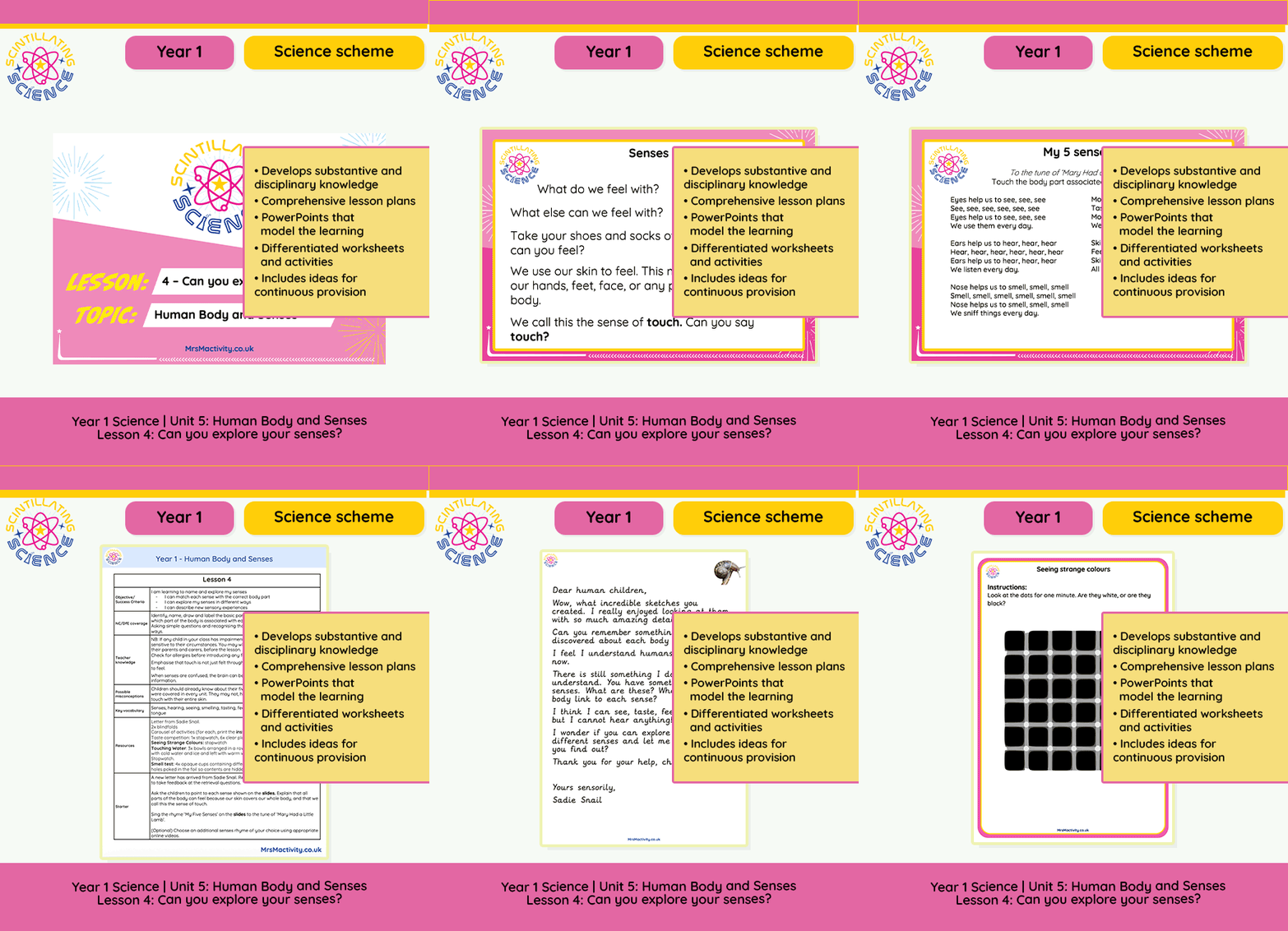
Lesson 4: Can you explore your senses?
Explore the five senses with this practical Year 1 science lesson. Pupils match sight, hearing, smell, taste and touch to the relevant parts of the body before taking part in a carousel of sensory activities and describing what they observe.
Aligned with the Year 1 Science National Curriculum, the lesson supports pupils to say which part of the body is associated with each sense. Pupils also develop early scientific enquiry skills by asking questions, making observations and discussing the results of practical sensory experiences.
What are the five senses?
Pupils explore sight, hearing, smell, taste and touch and connect each sense with the relevant body part. They also learn that touch can be detected through the skin across the body, rather than only through the hands and fingers.
How can we investigate our senses?
A practical carousel gives pupils opportunities to investigate their senses through activities involving colour perception, different water temperatures, locating sounds and identifying hidden items by smell. A blindfolded taste test provides another opportunity to explore sensory information.
Year 1 five senses lesson and resources
This lesson includes:
- Teacher lesson plan
- launchable teaching slides
- sensory investigation instruction cards
- five senses activity carousel
- practical sight, hearing, smell, taste and touch activities
- assessment questions
✨ How to use the launchable slides
Launch the presentation directly in your browser and use it on your interactive whiteboard.
📝 Click Notes to see teacher guidance, answers and additional information where included.
⬅️ ➡️ To move through the presentation, click on the slides first, then use the left and right cursor arrow keys on your keyboard.
For technical and copyright reasons, these presentation slides are available to launch online rather than download.
This lesson forms part of our Year 1 Human Body and Senses unit. Explore the wider Year 1 science curriculum and scheme or browse our primary science scheme of work.
This resource is part of the Mrs Mactivity Science Scheme of Work →