Year 6 light develops pupils’ understanding of how light travels, how we see objects and how shadows are formed. Linked to the Year 6 Science National Curriculum, pupils use the idea that light travels in straight lines to explain reflection, vision and the relationship between light sources, objects and shadows.
Across six lessons, pupils investigate light through practical enquiry and observation. Alongside the statutory Year 6 learning, the unit extends pupils’ experience of light through reflection, refraction, coloured shadows and the visible spectrum, helping them develop scientific vocabulary and use evidence to explain what they observe.
Pupils should be taught to:
Light forms part of the Scintillating Science Year 6 scheme. Explore the Year 6 science page to see curriculum coverage, progression and the other science units available for the year.
The Year 6 light programme of study builds on pupils’ earlier learning about light and shadows. Pupils develop a more detailed understanding that light travels in straight lines and use this idea to explain how we see objects, how reflection works and why shadows are formed.
A key Year 6 light National Curriculum objective is recognising that light appears to travel in straight lines. Pupils use observations, diagrams and practical enquiry to explore the path of light and apply this understanding when explaining vision, reflection and shadows.
Pupils learn that we see an object when light reaches our eyes. Luminous objects give out their own light, while non-luminous objects can be seen when light from a source reflects from their surface and travels into the eye. Pupils use this understanding to explain the path light takes from a source to the eye.
Through practical exploration of reflection, pupils investigate what happens when light reaches reflective surfaces and consider how its direction changes. This gives pupils opportunities to apply their knowledge that light travels in straight lines and explain their observations using scientific evidence.
Pupils use the idea that light travels in straight lines to explain how shadows are formed when an object blocks light. They explore the relationship between the light source, object and shadow and use their scientific understanding to explain why shadows have the same shape as the objects that cast them.
Alongside the statutory Year 6 Light objectives, pupils have opportunities to explore further light phenomena including refraction, coloured shadows and the visible spectrum. These experiences extend pupils’ knowledge of light and provide additional opportunities for observation, questioning and scientific discussion.
Practical Year 6 light investigations allow pupils to apply working scientifically skills within a meaningful context. Pupils make predictions, plan enquiries, observe and record what happens, identify patterns and use evidence alongside their scientific knowledge to explain their findings.
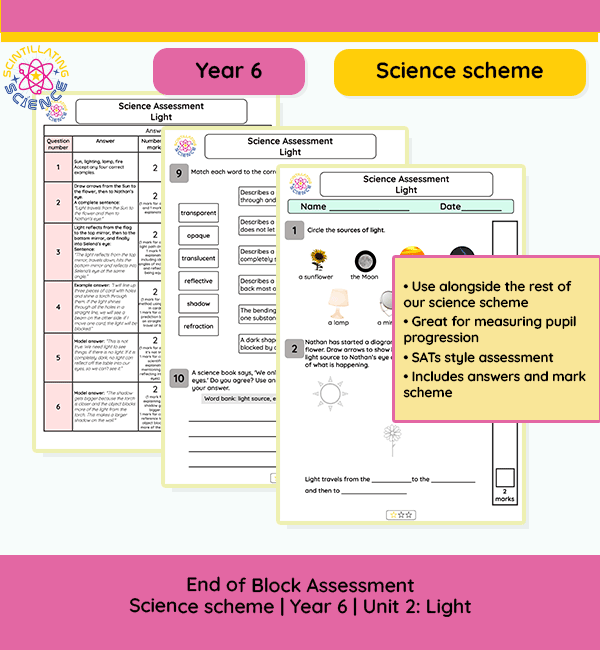
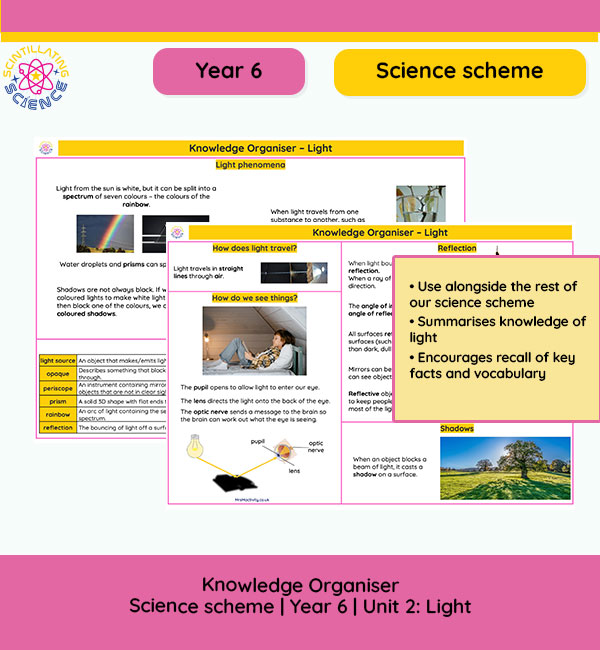
This Year 6 light unit includes six sequenced lessons, with resources to support teaching, scientific enquiry and assessment:
See how this unit fits into the wider curriculum and explore Year 6 science planning and resources, or browse our primary science scheme of work for Reception to Year 6.
| Cookie | Duration | Description |
|---|---|---|
| _fbp | 3 months | Facebook sets this cookie to display advertisements when either on Facebook or on a digital platform powered by Facebook advertising after visiting the website. |
| _ga | 1 year 1 month 4 days | Google Analytics sets this cookie to calculate visitor, session and campaign data and track site usage for the site's analytics report. The cookie stores information anonymously and assigns a randomly generated number to recognise unique visitors. |
| _ga_* | 1 year 1 month 4 days | Google Analytics sets this cookie to store and count page views. |
| _gcl_au | 3 months | Google Tag Manager sets the cookie to experiment advertisement efficiency of websites using their services. |
| Cookie | Duration | Description |
|---|---|---|
| edd-rvi | 3 months | Description is currently not available. |
| GFE_RTT | 5 minutes | No description available. |
| m | 1 year 1 month 4 days | No description available. |
| Cookie | Duration | Description |
|---|---|---|
| fr | 3 months | Facebook sets this cookie to show relevant advertisements by tracking user behaviour across the web, on sites with Facebook pixel or Facebook social plugin. |
| NID | 6 months | Google sets the cookie for advertising purposes; to limit the number of times the user sees an ad, to unwanted mute ads, and to measure the effectiveness of ads. |
| VISITOR_INFO1_LIVE | 6 months | YouTube sets this cookie to measure bandwidth, determining whether the user gets the new or old player interface. |
| VISITOR_PRIVACY_METADATA | 6 months | YouTube sets this cookie to store the user's cookie consent state for the current domain. |
| YSC | session | Youtube sets this cookie to track the views of embedded videos on Youtube pages. |
| yt-remote-connected-devices | never | YouTube sets this cookie to store the user's video preferences using embedded YouTube videos. |
| yt-remote-device-id | never | YouTube sets this cookie to store the user's video preferences using embedded YouTube videos. |
| yt.innertube::nextId | never | YouTube sets this cookie to register a unique ID to store data on what videos from YouTube the user has seen. |
| yt.innertube::requests | never | YouTube sets this cookie to register a unique ID to store data on what videos from YouTube the user has seen. |