Year 5 properties and changes of materials introduces pupils to the properties of everyday materials and how these properties affect the ways materials are used. Linked to the Year 5 Science National Curriculum, pupils investigate dissolving and reversible changes, compare and group materials, and use evidence to explain why particular materials are suitable for different purposes.
Across six lessons, pupils develop their understanding through practical investigations, observation, comparison and scientific discussion. They explore solubility, investigate reversible changes, compare soils and examine properties including hardness, transparency, conductivity and magnetism.
This unit supports pupils to:
Properties and Changes of Materials forms part of the Scintillating Science Year 5 scheme. Explore the full Year 5 sequence to see curriculum coverage, progression and the other science units available for the year.
The Year 5 properties and changes of materials programme of study builds pupils’ understanding of how materials can be compared according to their properties and why particular materials are suited to different purposes. Pupils also develop their understanding of dissolving, solutions and changes that can be reversed.
Pupils compare and group everyday materials according to their physical properties. This includes exploring hardness, solubility, transparency, electrical and thermal conductivity and magnetism, helping pupils move beyond simply naming materials to explaining how their properties affect their uses.
Through practical Year 5 dissolving investigations, pupils explore what happens when different materials are added to liquids. They learn to use scientific vocabulary including soluble, insoluble, solution, solute and solvent and use observations from their investigations to compare materials.
Year 5 pupils need to recognise that processes including dissolving, mixing and changes of state can be reversible changes. The unit gives pupils opportunities to investigate changes practically and explain whether a material can be returned to its original state.
Pupils apply their knowledge of material properties to explain why materials such as metals, wood and plastics are chosen for particular uses. Rather than simply identifying a suitable material, pupils are encouraged to justify their choices using evidence and scientific knowledge.
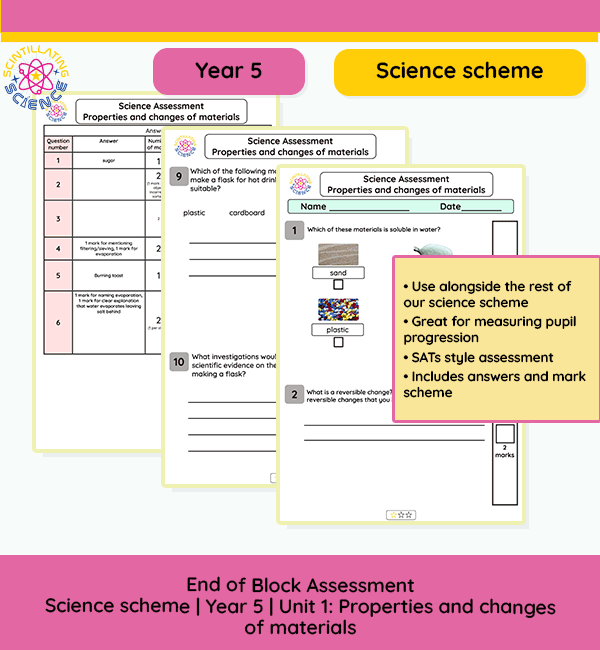
This unit includes six sequenced Year 5 science lesson plans with teaching slides, worksheets and practical investigations, alongside a knowledge organiser and assessment materials. The resources support teachers to teach scientific knowledge alongside relevant working scientifically skills, with activities ready to use across the unit.
See how this unit fits into the wider curriculum and explore the complete Year 5 science scheme, or view our primary science scheme of work for Reception to Year 6.
| Cookie | Duration | Description |
|---|---|---|
| _fbp | 3 months | Facebook sets this cookie to display advertisements when either on Facebook or on a digital platform powered by Facebook advertising after visiting the website. |
| _ga | 1 year 1 month 4 days | Google Analytics sets this cookie to calculate visitor, session and campaign data and track site usage for the site's analytics report. The cookie stores information anonymously and assigns a randomly generated number to recognise unique visitors. |
| _ga_* | 1 year 1 month 4 days | Google Analytics sets this cookie to store and count page views. |
| _gcl_au | 3 months | Google Tag Manager sets the cookie to experiment advertisement efficiency of websites using their services. |
| Cookie | Duration | Description |
|---|---|---|
| edd-rvi | 3 months | Description is currently not available. |
| GFE_RTT | 5 minutes | No description available. |
| m | 1 year 1 month 4 days | No description available. |
| Cookie | Duration | Description |
|---|---|---|
| fr | 3 months | Facebook sets this cookie to show relevant advertisements by tracking user behaviour across the web, on sites with Facebook pixel or Facebook social plugin. |
| NID | 6 months | Google sets the cookie for advertising purposes; to limit the number of times the user sees an ad, to unwanted mute ads, and to measure the effectiveness of ads. |
| VISITOR_INFO1_LIVE | 6 months | YouTube sets this cookie to measure bandwidth, determining whether the user gets the new or old player interface. |
| VISITOR_PRIVACY_METADATA | 6 months | YouTube sets this cookie to store the user's cookie consent state for the current domain. |
| YSC | session | Youtube sets this cookie to track the views of embedded videos on Youtube pages. |
| yt-remote-connected-devices | never | YouTube sets this cookie to store the user's video preferences using embedded YouTube videos. |
| yt-remote-device-id | never | YouTube sets this cookie to store the user's video preferences using embedded YouTube videos. |
| yt.innertube::nextId | never | YouTube sets this cookie to register a unique ID to store data on what videos from YouTube the user has seen. |
| yt.innertube::requests | never | YouTube sets this cookie to register a unique ID to store data on what videos from YouTube the user has seen. |