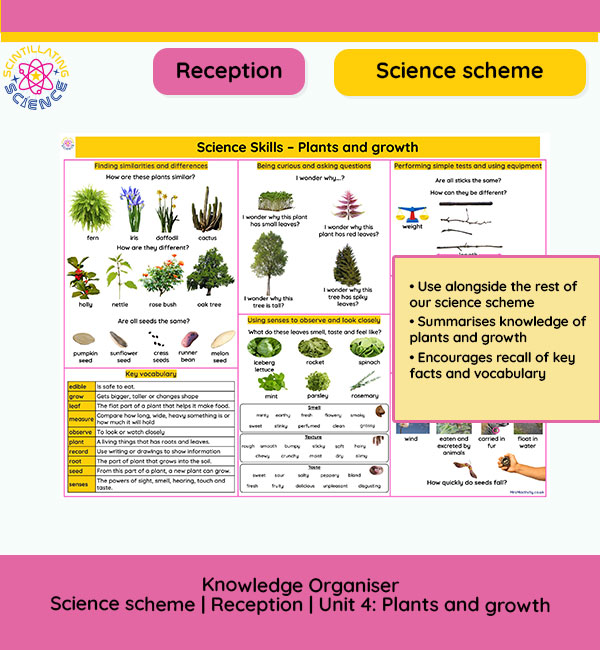
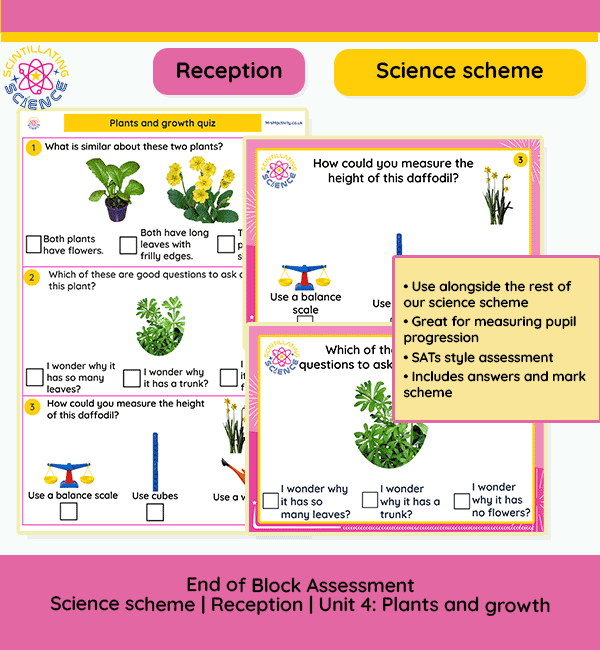
This Reception plants and growth science unit helps children explore seeds, plants and how living things change as they grow. Across six sequenced lessons, children plant and observe their own seeds, investigate different plants and leaves, explore the plant life cycle and begin to understand how seeds can travel to new places.
Children compare plants and seeds, ask questions about what they observe, measure and compare natural materials and use their senses to investigate edible leaves. A plant growth log runs through the unit so children can observe changes over time, measure their plants and discuss how light, water, soil and temperature can affect growth.
The unit supports The Natural World, giving children opportunities to explore plants in the world around them, make observations and drawings of plants and notice how plants change as they grow.
Plants and Growth is part of our wider Reception science curriculum, helping children build knowledge of plants and living things while developing observation, questioning, measuring and recording skills that provide foundations for science in Year 1.
Plants and Growth gives Reception children opportunities to explore plants through first-hand observation, growing, measuring and investigation. Children plant their own seeds at the beginning of the unit and revisit them regularly, giving them a meaningful way to observe and record changes over time.
Children plant their own seeds and look closely at different seeds and plants, comparing features such as colour, shape, leaves, stems and petals. They begin a plant growth investigation that continues across the unit, using a plant growth log to draw and record what they notice as their plants change.
Outdoor plant investigations encourage children to look closely, notice differences and ask their own questions. Children explore plant features and use prompts such as I wonder why…? to develop curiosity about the plants they find in their school or local environment.
Children collect sticks and use simple equipment to investigate their properties. They use magnifying glasses to observe them closely, measure length using non-standard units and compare weight using balance scales, developing practical experience of measuring, comparing and using equipment.
Children investigate edible leaves such as lettuce, spinach, rocket and herbs using sight, smell, touch and, where appropriate, taste. They compare colour, shape, size, texture, smell and taste and extend their observations through activities including leaf rubbings and scented playdough.
Children explore how plants change as they grow by sequencing the stages of a dandelion life cycle. They investigate seeds inside fruit, hunt for seeds in their local environment and compare their size, shape and colour. Children also begin to explore how seeds can move away from the parent plant.
By the end of the unit, children use their own growing investigation as evidence when talking about plant growth. They compare the plants they have grown, measure their height and consider how light, water, soil and temperature may have affected them. A practical sycamore seed investigation also helps children explore how the shape of a seed can affect the way it falls and travels.
The six-lesson unit includes:
Explore the wider Reception science curriculum and scheme, or see our complete primary science scheme of work.
| Cookie | Duration | Description |
|---|---|---|
| _fbp | 3 months | Facebook sets this cookie to display advertisements when either on Facebook or on a digital platform powered by Facebook advertising after visiting the website. |
| _ga | 1 year 1 month 4 days | Google Analytics sets this cookie to calculate visitor, session and campaign data and track site usage for the site's analytics report. The cookie stores information anonymously and assigns a randomly generated number to recognise unique visitors. |
| _ga_* | 1 year 1 month 4 days | Google Analytics sets this cookie to store and count page views. |
| _gcl_au | 3 months | Google Tag Manager sets the cookie to experiment advertisement efficiency of websites using their services. |
| Cookie | Duration | Description |
|---|---|---|
| edd-rvi | 3 months | Description is currently not available. |
| GFE_RTT | 5 minutes | No description available. |
| m | 1 year 1 month 4 days | No description available. |
| Cookie | Duration | Description |
|---|---|---|
| fr | 3 months | Facebook sets this cookie to show relevant advertisements by tracking user behaviour across the web, on sites with Facebook pixel or Facebook social plugin. |
| NID | 6 months | Google sets the cookie for advertising purposes; to limit the number of times the user sees an ad, to unwanted mute ads, and to measure the effectiveness of ads. |
| VISITOR_INFO1_LIVE | 6 months | YouTube sets this cookie to measure bandwidth, determining whether the user gets the new or old player interface. |
| VISITOR_PRIVACY_METADATA | 6 months | YouTube sets this cookie to store the user's cookie consent state for the current domain. |
| YSC | session | Youtube sets this cookie to track the views of embedded videos on Youtube pages. |
| yt-remote-connected-devices | never | YouTube sets this cookie to store the user's video preferences using embedded YouTube videos. |
| yt-remote-device-id | never | YouTube sets this cookie to store the user's video preferences using embedded YouTube videos. |
| yt.innertube::nextId | never | YouTube sets this cookie to register a unique ID to store data on what videos from YouTube the user has seen. |
| yt.innertube::requests | never | YouTube sets this cookie to register a unique ID to store data on what videos from YouTube the user has seen. |