Teach the ‘j’ grapheme and /j/ phoneme with our j phonics resources for Reception. These worksheets, games and practical activities help pupils recognise ‘j’, practise correct letter formation and apply their phonics knowledge when blending and segmenting simple words.
Use these teacher-made resources to introduce ‘j’, revisit previous learning or provide additional practice during whole-class lessons, small-group work and phonics interventions. Browse our complete collection of Phase 3 phonics resources, or explore teaching materials covering every phase on our main phonics resources page.
In Phase 3 phonics, pupils learn to connect the written grapheme ‘j’ with the /j/ phoneme heard at the beginning of words such as jam, jet and jog. They practise recognising the grapheme, saying the phoneme clearly and identifying /j/ within spoken words.
Secure recognition of ‘j’ helps pupils apply their growing knowledge of grapheme–phoneme correspondences when reading and spelling words containing the newly taught grapheme.
Our j phonics worksheets and activities provide regular opportunities to revisit and apply the ‘j’ grapheme and /j/ phoneme. Resources support pupils with:
Use the resources for whole-class teaching, adult-led groups, independent activities or targeted phonics interventions. They can be selected to complement your school’s chosen systematic synthetic phonics programme.
Once pupils know ‘j’ alongside other taught graphemes, they can practise blending phonemes to read simple words such as jam, jet and jog. Word-building activities, phoneme frames and decodable reading tasks give pupils opportunities to apply their phonics knowledge when reading.
When spelling, pupils can say a word slowly, identify each phoneme and select the graphemes needed to represent it. Moving regularly between reading and spelling helps strengthen understanding of the ‘j’ grapheme–phoneme correspondence.
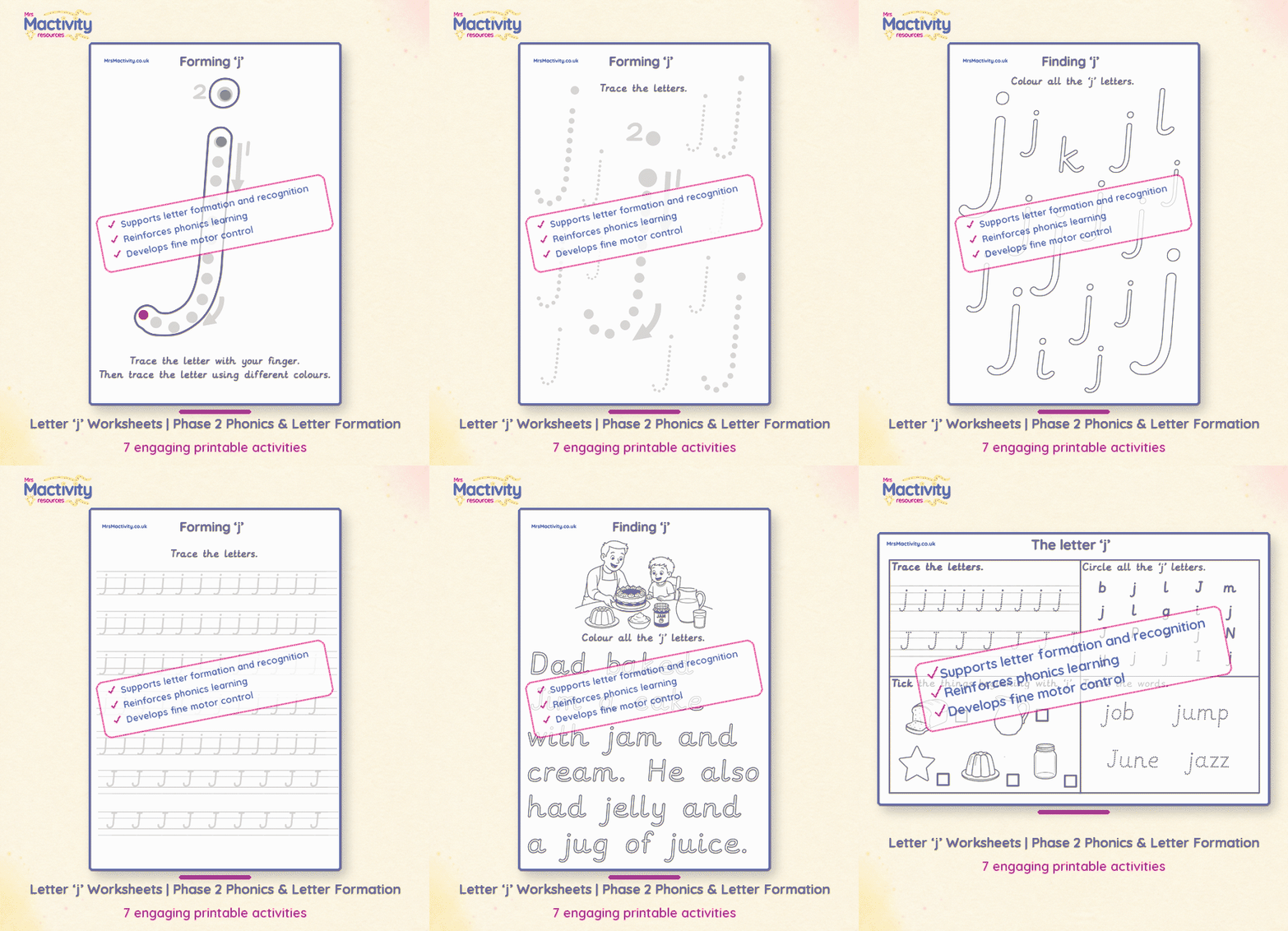
Letter formation activities help pupils connect the visual shape of ‘j’ with the phoneme it represents. Tracing, writing, fine motor tasks and multisensory activities provide repeated practice while pupils develop the control needed to form the grapheme independently.
Browse our complete collection of Phase 3 phonics resources for activities covering the wider teaching sequence. You can also visit our main phonics resources page to explore worksheets, games, lesson presentations and practical activities for Phases 1 to 5.
In Phase 3 phonics, the grapheme ‘j’ is introduced as a representation of the /j/ phoneme heard at the beginning of words such as jam, jet and jog.
Yes. The ‘j’ grapheme representing the /j/ phoneme is introduced during Phase 3 phonics.
Pupils can practise through grapheme-recognition games, oral sound activities, letter formation, word building, phoneme frames and decodable reading activities. Short, regular opportunities to revisit ‘j’ help pupils develop secure recall and apply the grapheme when reading and spelling.
| Cookie | Duration | Description |
|---|---|---|
| _fbp | 3 months | Facebook sets this cookie to display advertisements when either on Facebook or on a digital platform powered by Facebook advertising after visiting the website. |
| _ga | 1 year 1 month 4 days | Google Analytics sets this cookie to calculate visitor, session and campaign data and track site usage for the site's analytics report. The cookie stores information anonymously and assigns a randomly generated number to recognise unique visitors. |
| _ga_* | 1 year 1 month 4 days | Google Analytics sets this cookie to store and count page views. |
| _gcl_au | 3 months | Google Tag Manager sets the cookie to experiment advertisement efficiency of websites using their services. |
| Cookie | Duration | Description |
|---|---|---|
| edd-rvi | 3 months | Description is currently not available. |
| GFE_RTT | 5 minutes | No description available. |
| m | 1 year 1 month 4 days | No description available. |
| Cookie | Duration | Description |
|---|---|---|
| fr | 3 months | Facebook sets this cookie to show relevant advertisements by tracking user behaviour across the web, on sites with Facebook pixel or Facebook social plugin. |
| NID | 6 months | Google sets the cookie for advertising purposes; to limit the number of times the user sees an ad, to unwanted mute ads, and to measure the effectiveness of ads. |
| VISITOR_INFO1_LIVE | 6 months | YouTube sets this cookie to measure bandwidth, determining whether the user gets the new or old player interface. |
| VISITOR_PRIVACY_METADATA | 6 months | YouTube sets this cookie to store the user's cookie consent state for the current domain. |
| YSC | session | Youtube sets this cookie to track the views of embedded videos on Youtube pages. |
| yt-remote-connected-devices | never | YouTube sets this cookie to store the user's video preferences using embedded YouTube videos. |
| yt-remote-device-id | never | YouTube sets this cookie to store the user's video preferences using embedded YouTube videos. |
| yt.innertube::nextId | never | YouTube sets this cookie to register a unique ID to store data on what videos from YouTube the user has seen. |
| yt.innertube::requests | never | YouTube sets this cookie to register a unique ID to store data on what videos from YouTube the user has seen. |