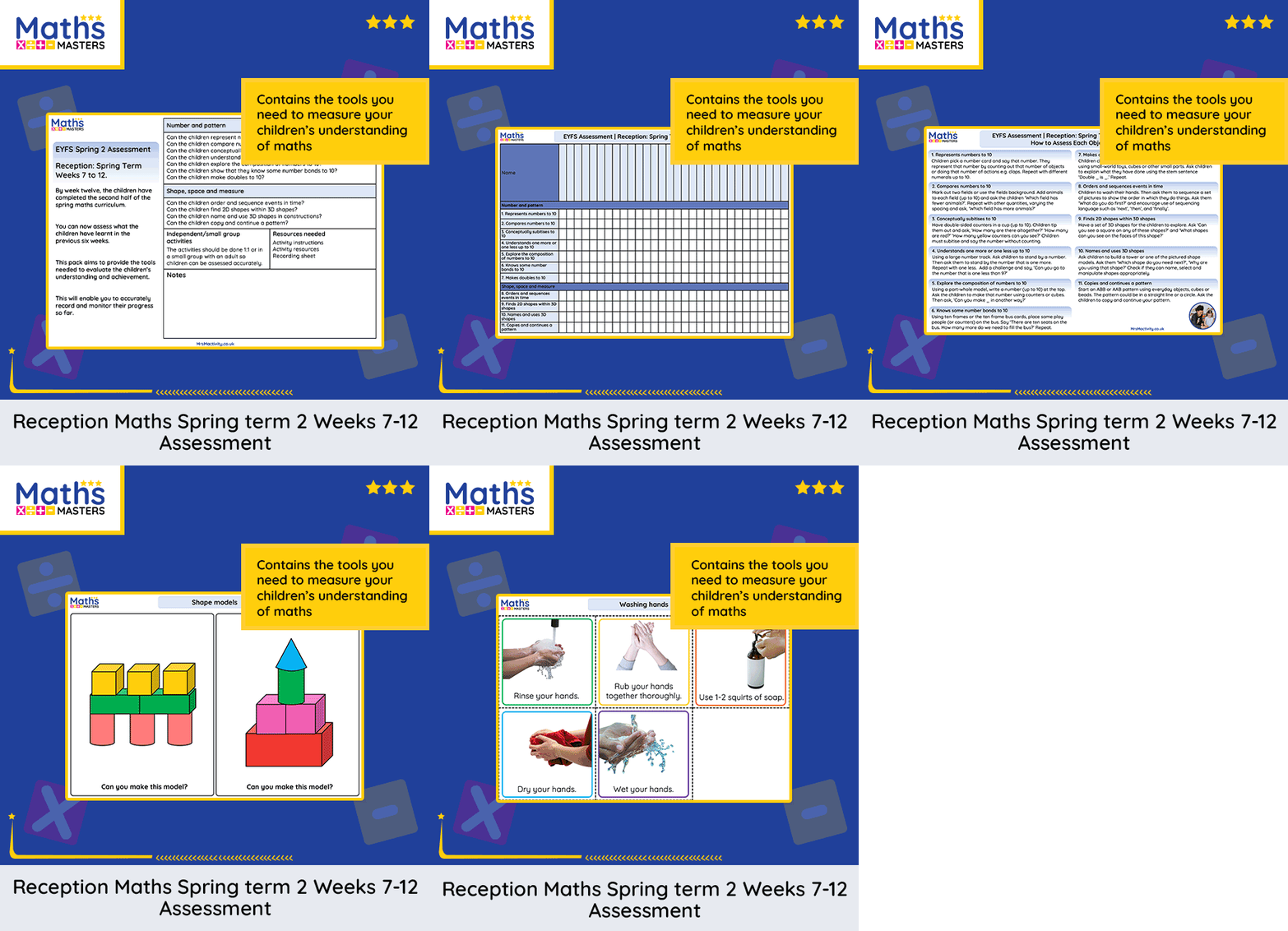
Reception Maths Spring Block 6 focuses on 3-D shapes and patterns, helping pupils develop shape recognition, pattern awareness and early spatial reasoning. Aligned with the EYFS framework and White Rose Maths progression, pupils build strong foundations through practical exploration, mathematical talk and opportunities to investigate shapes and patterns in the environment.
Across the block, pupils recognise and name 3-D shapes, explore how they can be used and identify 2-D shapes within 3-D objects. They then move on to identifying, copying and continuing more complex patterns, making connections between mathematical ideas and the world around them.
Spring Block 6 forms part of the Maths Masters Reception Spring sequence. Explore the full term to see how work with 3-D shapes, patterns and spatial reasoning fits into the wider Reception maths progression.
Exploring 3-D shapes in Reception gives pupils opportunities to handle, compare and investigate shapes in meaningful contexts. Rather than relying only on recognising shape names, pupils explore 3-D shapes through practical experiences and begin to notice their features and how they can be used.
Practical EYFS 3-D shape activities help pupils recognise and name familiar 3-D shapes and find examples in their surroundings. Exploring 2-D shapes within 3-D objects also helps pupils make connections between different aspects of shape and develop their mathematical vocabulary.
Pattern activities in Reception help pupils recognise structure, predict what comes next and explain the rules they notice. Pupils develop their earlier pattern work by identifying, copying and continuing more complex patterns and finding examples in the environment.
Shape and pattern exploration gives pupils opportunities to notice relationships, make predictions and explain their thinking. These practical experiences support spatial reasoning while building strong foundations for later geometry and mathematical problem-solving.
See how this block fits within the wider term sequence and explore Reception Spring maths planning.
| Cookie | Duration | Description |
|---|---|---|
| _fbp | 3 months | Facebook sets this cookie to display advertisements when either on Facebook or on a digital platform powered by Facebook advertising after visiting the website. |
| _ga | 1 year 1 month 4 days | Google Analytics sets this cookie to calculate visitor, session and campaign data and track site usage for the site's analytics report. The cookie stores information anonymously and assigns a randomly generated number to recognise unique visitors. |
| _ga_* | 1 year 1 month 4 days | Google Analytics sets this cookie to store and count page views. |
| _gcl_au | 3 months | Google Tag Manager sets the cookie to experiment advertisement efficiency of websites using their services. |
| Cookie | Duration | Description |
|---|---|---|
| edd-rvi | 3 months | Description is currently not available. |
| GFE_RTT | 5 minutes | No description available. |
| m | 1 year 1 month 4 days | No description available. |
| Cookie | Duration | Description |
|---|---|---|
| fr | 3 months | Facebook sets this cookie to show relevant advertisements by tracking user behaviour across the web, on sites with Facebook pixel or Facebook social plugin. |
| NID | 6 months | Google sets the cookie for advertising purposes; to limit the number of times the user sees an ad, to unwanted mute ads, and to measure the effectiveness of ads. |
| VISITOR_INFO1_LIVE | 6 months | YouTube sets this cookie to measure bandwidth, determining whether the user gets the new or old player interface. |
| VISITOR_PRIVACY_METADATA | 6 months | YouTube sets this cookie to store the user's cookie consent state for the current domain. |
| YSC | session | Youtube sets this cookie to track the views of embedded videos on Youtube pages. |
| yt-remote-connected-devices | never | YouTube sets this cookie to store the user's video preferences using embedded YouTube videos. |
| yt-remote-device-id | never | YouTube sets this cookie to store the user's video preferences using embedded YouTube videos. |
| yt.innertube::nextId | never | YouTube sets this cookie to register a unique ID to store data on what videos from YouTube the user has seen. |
| yt.innertube::requests | never | YouTube sets this cookie to register a unique ID to store data on what videos from YouTube the user has seen. |